
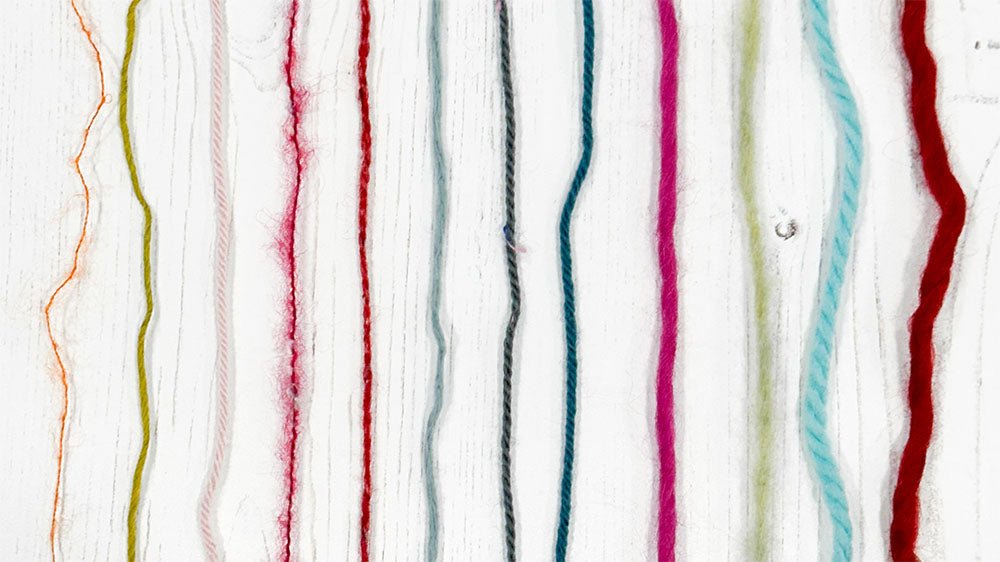
Yarn weight means the thickness of the yarn, not how much the ball weighs — and it is the single most important thing to get right when you choose a yarn for a pattern. The chart below gives every weight from lace to super chunky, with the UK, US and Australian names side by side, the needle size, the tension and the wraps per inch.
Every row is tappable: open it to see a yarn we stock in that weight, or go straight to the whole range. If you are holding a ball with no label, skip to measuring wraps per inch.
Thilde works through each weight in turn, shows you how to read a ball band, and measures wraps per inch on camera.
Jump to a section of the video
- What yarn weight means, and the thickest yarn we stock 0:56
- Two strands of chunky make a super chunky 2:15
- Aran, worsted, and what ‘ply’ actually means 3:53
- Why DK is called DK 4:41
- 4ply — and why a ‘2 ply’ can be the same thickness 6:44
- Lace, super fine, and what to use instead 8:35
- Measuring wraps per inch 11:11
- Why tension is always measured in stocking stitch 13:42
Every point Thilde makes is written out below too, so you can read it instead of watching if you prefer.
What is yarn weight?
Yarn weight refers to the thickness of the strand — nothing else. It has nothing to do with how much the ball weighs. A 100g ball of lace and a 100g ball of super chunky weigh exactly the same; the lace one simply holds far more metres of a much finer strand.
The thickest weight we stock is super chunky, which is what Rowan Big Wool is. It is not the thickest that exists — there is jumbo above it, sold for arm knitting — but we deliberately don’t stock jumbo. Arm-knitted blankets in jumbo yarn pull out of shape badly, and we would rather not sell you something that will disappoint you in a fortnight.
Confusingly, three naming systems are in use at once. The UK names yarns by ply or by tradition — 4ply, DK, aran, chunky. The US uses a numbered standard from 0 to 7 alongside descriptive names like fingering, worsted and bulky; worsted in particular you will mostly meet in American patterns. Australia and New Zealand name almost everything by ply. A pattern written in one system will cheerfully ask for a yarn you know by another name, which is what the chart below is for.
What ‘ply’ actually means
Ply means folded. Strictly, a 10 ply should be ten strands of fibre spun together — but count the strands in a ball of aran and you will not find ten. The number has stopped describing the construction and become nothing more than a reference point for thickness. Chunky is called 12 ply and super chunky 16 ply, which is not double, even though two strands of chunky held together really do give you a super chunky.
That mismatch is why the same yarn can carry two different numbers. Jamieson & Smith 2 Ply Jumper Weight is genuinely two folded plies, and it knits up at exactly the same thickness as a yarn labelled 4ply. Both are correct. One is counting how the yarn was made; the other is telling you what it knits like.
Can I hold two yarns together to make a thicker one?
Yes, and it is one of the more useful things to know. Two strands of a chunky yarn held together knit up as a super chunky. So if a pattern calls for super chunky and the colour you want only comes in chunky, you have a way forward.
Better still, hold two different chunky yarns together. You still get super chunky, and you get a colour play you cannot buy in a single ball. It also works with texture — a smooth chunky held with a brushed one gives you a halo the smooth yarn alone would never produce.
Knit a tension square before you commit, because held-together yarns rarely land exactly on the band figures for either yarn.
How do I know what weight my yarn is?
Look at the ball band first. Almost every band names the weight, and if it doesn’t, it gives you two figures that tell you anyway: the recommended needle size, and the tension — the number of stitches over 10cm. Match either against the chart below.
The band also gives the metres per ball, which matters as much as the weight once you are buying for a project. Two yarns can both be DK and differ by 40 metres a ball. At the fine end the numbers get startling: our lace runs to around 800 metres in a single skein, which is why we wind those for customers rather than leave you to it — without a swift and a ball winder you would be at it for hours.
If the band is long gone, which describes a good half of most stashes, measure it instead. In practice the confusion almost always sits between DK and aran, and this settles it in about a minute.
How to measure wraps per inch
Wraps per inch, or WPI, is the reliable way to identify an unlabelled yarn, and you need nothing more than a knitting needle and a tape measure.
Wrap the yarn round the needle, laying each strand snugly against the last without squashing them together or stretching the yarn as you go. Hold the tape measure alongside and wrap across one inch, then count the wraps.
When we did this on camera with Rowan Big Wool we counted six wraps in an inch, and six is squarely in the super chunky band. Doing the same with a 4ply gave eighteen, which sits at the bottom of the 18–24 band for that weight — exactly where it should be.
A piece of card with an inch marked on it works just as well as a needle. What you wrap around doesn’t matter, because what you are really measuring is how many strands of this yarn sit side by side in an inch.
Wrap the same yarn three times in three places along the ball and take the middle figure. Hand-wrapping is never perfectly consistent, and one count can land you a whole category out — which matters most at the fine end, where the bands sit closest together.
Yarn weights chart
| Standard | UK | US | AUS ply | Needle size | Tension per 10cm | Wraps per inch | Shop |
|---|---|---|---|---|---|---|---|
| 0 – LaceLace · 2 ply | Lace | Lace | 2 ply | 1.5 – 2.5 mm | Over 36 stitches | Over 36 wpi | Shop lace yarn → |
See a yarn in this weightKnitting for Olive Soft Silk Mohair — a fine silk-mohair usually held with another yarn to add a halo, and one of our most-bought yarns. Lace skeins run long: some reach 800 metres, which is why we wind them for you in the shop. | |||||||
| 1 – Super Fine3 ply · light fingering | 3 ply | Light fingering | 3 ply | 2.0 – 3.25 mm | 28 – 36 stitches | 30 – 36 wpi | Shop 4ply yarn → |
See a yarn in this weightWe don’t stock super fine. We used to carry one, and it was discontinued — it is mostly bought for baby shawls and there isn’t the demand to justify it. For a pattern written in 3ply, go either down to a lace weight or up to a 4ply and change needle size to match. Jamieson & Smith 2 Ply Jumper Weight is a good 4ply choice despite the name — the ‘2 ply’ counts how it is spun, not how it knits. | |||||||
| 2 – Fine4 ply · fingering | 4 ply | Fingering | 4 ply | 2.0 – 3.75 mm | 24 – 28 stitches | 18 – 24 wpi | Shop 4ply yarn → |
See a yarn in this weightKnitting for Olive Merino — a soft, round 4ply merino that takes colour beautifully and is our most popular yarn at this weight. | |||||||
| 2 – Fine4 ply · sport · 5 ply | 4 ply | Sport | 5 ply | 3.25 – 3.75 mm | 24 – 28 stitches | 12 – 18 wpi | Shop 4ply yarn → |
See a yarn in this weightSport sits between 4ply and DK, and UK patterns rarely call for it by name. Start with the heavier end of our 4ply — West Yorkshire Spinners Signature 4ply is a hard-wearing choice. | |||||||
| 3 – LightDK · 8 ply | DK | DK | 8 ply | 3.75 – 4.5 mm | 20 – 24 stitches | 10 – 12 wpi | Shop DK yarn → |
See a yarn in this weightOrry Yarn Merino DK — our own DK, and the weight most UK patterns are written for. If you are unsure where to start, start here. | |||||||
| 4 – MediumAran · worsted · 10 ply | Aran | Worsted | 10 ply | 4.5 – 5.5 mm | 16 – 20 stitches | 8 – 10 wpi | Shop aran yarn → |
See a yarn in this weightRowan Kid Classic — a lambswool and mohair blend with a soft halo, and a favourite for cabled knits. Note that aran and worsted are close but not identical: see the swapping section below. | |||||||
| 5 – BulkyChunky · 12–14 ply | Chunky | Bulky | 12 – 14 ply | 5.5 – 8.0 mm | 12 – 16 stitches | 6 – 8 wpi | Shop chunky yarn → |
See a yarn in this weightWYS Retreat Chunky Roving — a lofty, lightly spun British wool that knits up fast and blocks out beautifully. | |||||||
| 6 – Super BulkySuper chunky · 16 ply | Super chunky | Super bulky | 16 ply | 8 – 15 mm | Under 11 stitches | Under 6 wpi | Shop Rowan Big Wool → |
See a yarn in this weightRowan Big Wool — the classic super chunky, and the yarn we hand to most complete beginners because your progress is visible within minutes. | |||||||
Working out how many balls to buy? See How much yarn do I need? — and for the needle sizes in full, our knitting needle and crochet hook conversion chart.
Why tension is always measured in stocking stitch
This one catches people out constantly. A tension figure on a ball band — say 11 stitches or fewer over 10cm for super chunky — is measured in stocking stitch: a row knit, a row purl, a row knit. In Denmark we call it flat knitting, which describes it rather well, because it lies flat and even.
If the band doesn’t name a stitch pattern, stocking stitch is what it means. So measuring your tension over a rib will not match, and neither will a cable or a textured panel. Ribbing pulls in, cables pull in harder, and both will read as far more stitches to the 10cm than the band claims. There is nothing wrong with your knitting; you are simply measuring a different fabric.
Knit your tension square in stocking stitch, even when the project itself is ribbed or cabled.
Why does yarn weight matter?
The thickness of the yarn decides the feel and the drape of what you make. The same pattern in 4ply and in aran gives two genuinely different garments — one fine and fluid, one dense and warm — and only one will come out the size the pattern promised.
That is because a pattern is really a set of instructions about stitch counts, and stitch counts only become centimetres through tension. Knit it in a finer yarn than specified and every stitch is smaller, so the finished piece is smaller. Thicker yarn, bigger piece. On a scarf that hardly matters. On a jumper it is the difference between a garment that fits and one that doesn’t.
Fibre matters alongside thickness, and not always in the way you would guess. A fine Shetland 4ply is the classic choice for colourwork — but not because it is fine. It is because it is wool. Wool felts very slightly as it is worked and washed, and that stabilises the floats and settles the colours into each other in a way a smooth cotton or silk of the same thickness never will.
Can I use a different weight from the one the pattern asks for?
Sometimes. It depends how far apart the two weights are, and how much the finished measurements matter.
Neighbouring weights are worth attempting. DK and worsted, or aran and worsted, are close enough that a tension square will tell you whether it works — usually by changing needle size, or by knitting a different size from the one you would normally pick. Jumping two categories, 4ply for aran say, means rewriting the pattern rather than substituting a yarn.
Shawls are the forgiving case, and it is why substitution comes up most often there. A shawl doesn’t have to fit anybody, so if it comes out a little larger or smaller than the pattern says, nothing is lost. That is why a pattern written for a 3ply is so often knitted in either a lace weight or a 4ply instead — going down means going down a needle size, going up means going up one.
Scarves, cowls and blankets give you the same freedom: work to a fabric you like the feel of, and add or remove rows to reach the length you want. For anything fitted, knit the tension square first, compare it against the pattern’s tension, and only then decide.
The weight on the ball band gets you to the right shelf. The tension square gets you the right size. Neither replaces the other.
Yarns mentioned in this guide

Orry Yarn
Orry Yarn Merino DK
Our own DK — the weight most UK patterns are written for, and the best place to start.
Shop Merino DK
Knitting for Olive
Knitting for Olive Merino
A soft, round 4ply merino, and our most popular yarn at the fine end of the chart.
Shop KFO Merino
Rowan
Rowan Big Wool
Super chunky, on big needles — the fastest way to see real progress as a beginner.
Shop Big WoolNot sure which weight you need?
Browse the whole range and filter by weight, fibre and brand — or send us a photo of your ball band and we’ll tell you what it is.
Shop all yarn